What Is a Site Survey? Your Guide to Network Planning
Learn how to conduct a Wi-Fi site survey to get rid of dead zones and improve your connection speeds. From active vs. passive surveys to NetSpot tutorials, we’ve got you covered!
When you start planning a home office or setting up a complex corporate network, everything comes down to one thing: a reliable connection. This is where a wireless site survey — often referred to as a Wi-Fi coverage analysis — becomes essential.
Essentially, it is a systematic process of mapping out an area to see how airwaves behave, how well a specific network covers the space, and exactly where your access points should go. Skipping this step usually leads to the usual frustrations: sudden dropouts, dead zones, and heavy interference.
A proper survey stops the guesswork. It translates vague complaints into clear, measurable data, showing you exactly where the signal dies, where interference chokes your speed, and whether the network actually delivers where you need it most.
Why Is a Site Survey Important?
Checking your WiFi environment isn’t some exclusive task for IT departments — it’s for anyone who is simply tired of a flaky connection. Think of a site survey as a quick health check for your wireless network. To see why it’s worth the effort, just think of all the daily tech annoyances it helps you avoid:
- Frustrating slowdowns: Staring at a spinning buffer wheel or waiting ages for a page to load is usually the reality for anyone stuck with an unoptimized network. A survey tracks down exactly where your speed is bleeding out.
- Sudden connection drops: We’ve all been in the middle of a critical video call when the screen freezes and everything goes silent. Mapping your space ensures you get a seamless connection that doesn't cut out when you move from room to room.
- Dead zones: These are areas where the WiFi signal disappears entirely — like that one corner where apps refuse to refresh. A survey reveals these hidden black holes so you can eliminate them.
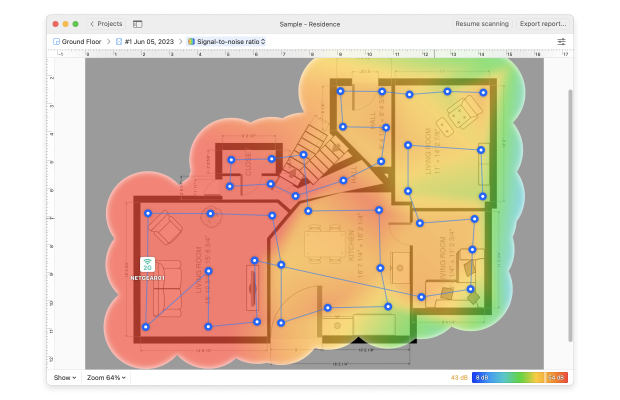
- Hidden interference: Household appliances and neighboring routers constantly compete for airwaves. Identifying available networks and their broadcast channels allows you to switch to cleaner, unobstructed frequencies.
- Capacity bottlenecks: High-density environments like modern offices or schools can easily overwhelm a router. Planning for capacity ensures you place the right number of access points exactly where demand is highest.
Collecting WiFi data does not automatically fix these issues. However, it provides the precise diagnostic baseline needed to understand your network's current state and deploy effective upgrades.
What Are the Types of Site Surveys?
There are three main distinct types of WiFi site surveys you should know about.
Passive
A passive survey involves walking through a space and collecting data about existing WiFi networks without actually connecting to them. This type of survey is useful for understanding the overall RF environment and identifying potential sources of interference.
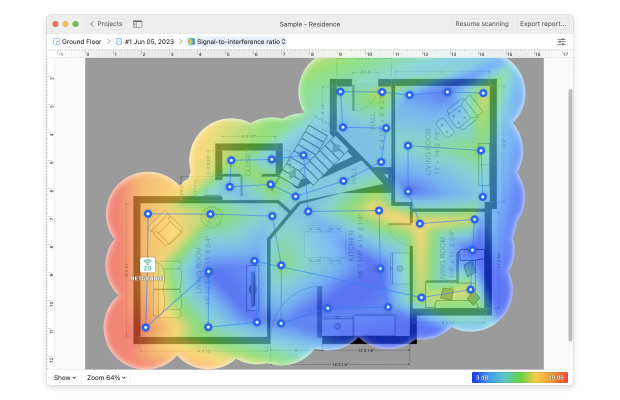
For example, a network administrator might use WiFi survey software on a laptop to perform a passive survey of an office building to discover if there isn't a rogue network operating within the premises.
Active
An active survey goes a step further by actually connecting to the network being surveyed. This allows for more detailed performance metrics to be collected, such as actual throughput.
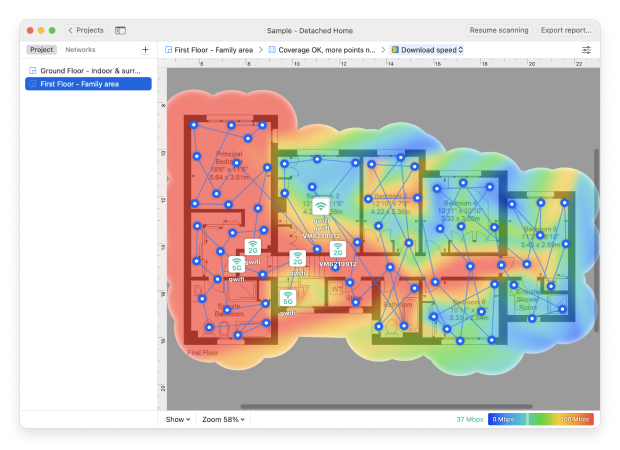
In practice, active surveys are often used to troubleshoot pesky issues. A good example would be a coffee shop owner trying to figure out why customers complain about slow Wi-Fi in certain areas. The owner might use a laptop with the WiFi site survey software to conduct an active survey. They would connect to their network and walk around the shop, stopping at various points to measure real-world performance.
Predictive
A predictive survey uses software to simulate WiFi coverage based on a floor plan and known characteristics of the space and equipment. This type of survey is useful when planning a new network installation or when physical access to a site is limited. NetSpot also offers predictive survey functionality on Android, a capability that is still uncommon among WiFi planning solutions.
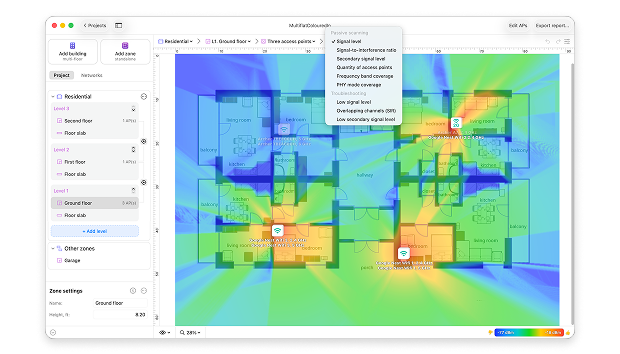
For instance, when planning WiFi deployment for a new house, the homeowner might use predictive survey software to build a digital simulation of the area and input details like wall materials, floor plans, and proposed access point models.
Starting with NetSpot 6, this type of planning can cover not only single-level spaces but entire multi-floor buildings. Instead of treating each floor as a separate plan, you can create multiple levels within one building and model how WiFi signals spread both across individual floors and vertically between them.
This gives you a much more realistic predictive planning of coverage in multi-story houses, offices, hotels, hospitals, schools, and other buildings where coverage between floors matters.
For a multi-story house, NetSpot can also take the floor slabs between levels into account. You can specify the slab thickness and material, including custom reflection and absorption values, and add cutouts for stairwells or other openings where the slab is absent. Once the levels are aligned, these details help NetSpot model how the signal spreads between floors more accurately.
Which type of WiFi site survey do I need?
Use a passive survey when you want to understand the wireless environment around you: nearby networks, signal levels, channels, and possible interference.
Use an active survey when you need to test the real user experience on your own network, including actual download speed, upload speed, and latency in different rooms.
Use a predictive survey when you are planning a new wireless network or want to test access point placement before moving hardware, drilling holes, or buying additional equipment.
In simple terms: passive shows what the WiFi environment looks like, active shows how your network actually performs, and predictive helps you plan what to change before you change it.
When Is a Site Survey Done for a Wireless Network?
The short answer is that a WiFi site survey should be done before, during, and after deployment.
- Before deployment: Use a predictive survey to plan optimal AP placement and estimate hardware needs.
- During deployment: Perform passive and active surveys to compare real-world performance with the predicted design.
- After deployment: Once users are actively on the network, survey again to fix any dead zones or interference issues that might appear under load.
Checklist before you start
Before you dive into measuring signals, it’s worth getting everything in order. Here’s a quick checklist to guide you:
- Grab a building plan or layout. Make sure you have an accurate map of the space. If there isn’t one on hand, try to sketch a rough version yourself or check an online satellite image.
- Clarify your objectives. Figure out what you’re aiming to improve — eliminating dead zones, boosting speeds, handling a larger number of users, or fixing sporadic disconnections.
- Gather your tools. You’ll need Wi-Fi survey software (NetSpot is a good option), a laptop or mobile device, any necessary power cables, and some way to take notes.
- Account for building materials. Different materials — concrete, glass, metal, thick drywall — can all affect how signals pass through, so factor this in when planning.
- Pick the right time. Try to do your survey when the network experiences typical use (for offices, that might be during regular work hours). This will give you a realistic view of performance.
- Keep track of the details. Write down exactly where you measure signals, note any sources of interference, and mark areas that might need more coverage. By covering these bases upfront, you’re less likely to miss anything crucial when it’s time to measure signal strength and overall network performance.
Tip: Read more about how to plan a WiFi deployment so that your network is set up for success from the start.
How to collect survey data that is actually useful
A site survey is only as good as the data you collect. In our internal review of NetSpot support cases, many confusing reports came from three simple mistakes: the floor plan scale was not calibrated correctly, too few measurement points were collected, or the survey was done at a time when the network was not being used normally.
When it comes to a small apartment or home office, it's important to take measurements in every room where internet is actually needed, rather than limiting the area to the router. In commercial spaces — whether an office, classroom, warehouse, or cafe — data collection points should clearly correspond to areas where people work, sit, walk, and actively use devices.
Moreover, it's crucial to consider the context of the problem. If the network starts to slow down in the evenings, at least one measurement should be taken during that time. And if video calls are consistently disconnecting in a specific room, testing should be done there and at the very moment the problems occur.
As a practical rule, your measurement points should be close enough that the blue data circles overlap slightly. If there are big empty spaces between points, the heatmap may look smooth, but it may hide the real problem.
How to Do a Site Survey
For home users, a simple site survey might involve walking around with a smartphone app to identify dead zones, while business owners and enterprises might use a more advanced desktop tool to map signal strength across their premises.
Regardless of which of these camps you belong to, you can use NetSpot to quickly and easily conduct a highly accurate site survey.
NetSpot offers a user-friendly interface that’s accessible to both beginners and professionals, provides detailed heatmaps for visual analysis, and works on multiple platforms, including macOS, Windows, and mobile devices.
Here is a step-by-step guide on how to do a site survey using the desktop version of NetSpot:
Step 1
Download and install NetSpot on your laptop.
Step 2
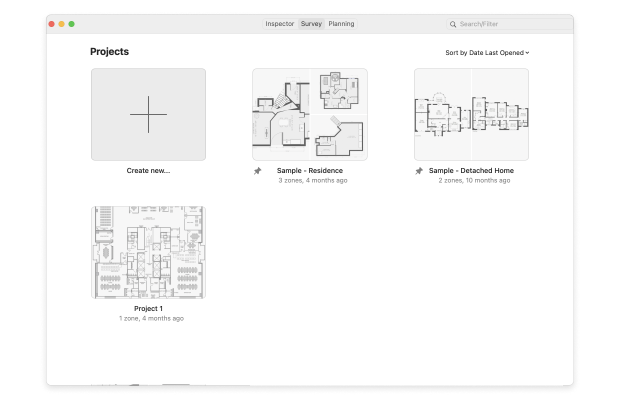
Open NetSpot and switch to the Survey tab. Select “Create New…” to begin your new project.
Step 3
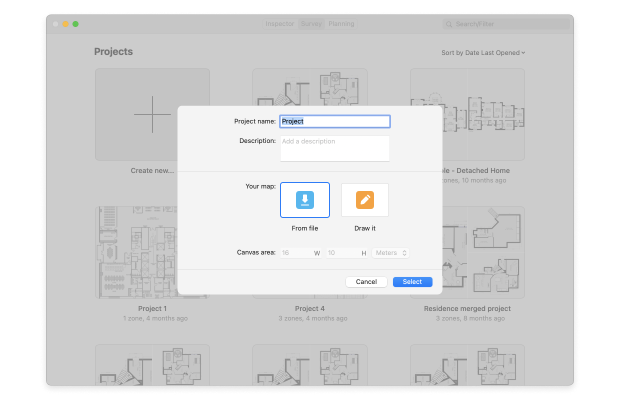
You can import a prepared floor plan or draw a new one directly in NetSpot. For uploaded plans, you’ll need to calibrate the scale.
Step 4
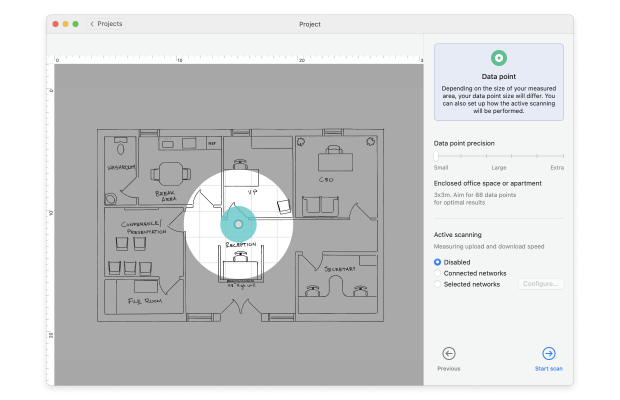
Set the sampling distance (how often you’ll take measurements) and choose whether to run active or passive scanning.
Step 5
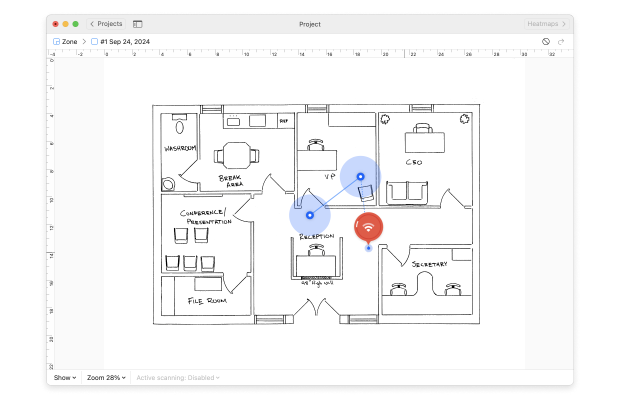
Click Start Scan and move to your first measuring point. Click on the matching location on your map. And move around your space, stopping at regular intervals to take measurements. Ensure the blue circles on your map overlap slightly for comprehensive coverage.
Step 6
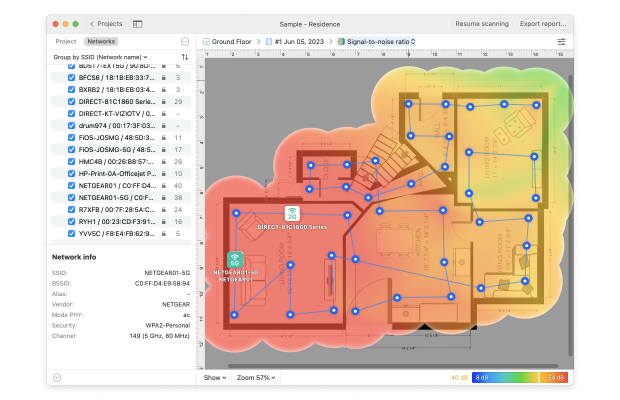
Once you’ve covered your area, click Heatmaps to view your results. You can choose different heatmap types to analyze various aspects of your network.
For mobile users, NetSpot offers a powerful app that allows you to build realistic WiFi heatmaps right on your iOS, iPadOS, or Android device in minutes, without additional expensive hardware. The app includes additional features like:
- WiFi analyzer for diagnosing your wireless networks and connection speed
- WiFi scanner for collecting and visualizing your WiFi data
- WiFi tester for checking your Internet speed and recording historical results
- Planning Mode (Android only) for virtually planning and simulating WiFi network deployments

Mobile WiFi survey and analysis
Inspect, compare, survey, and analyze WiFi networks with NetSpot.
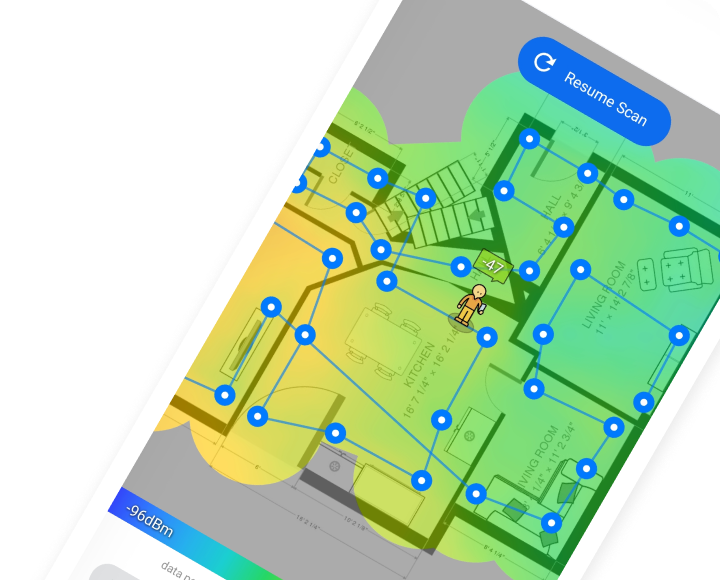
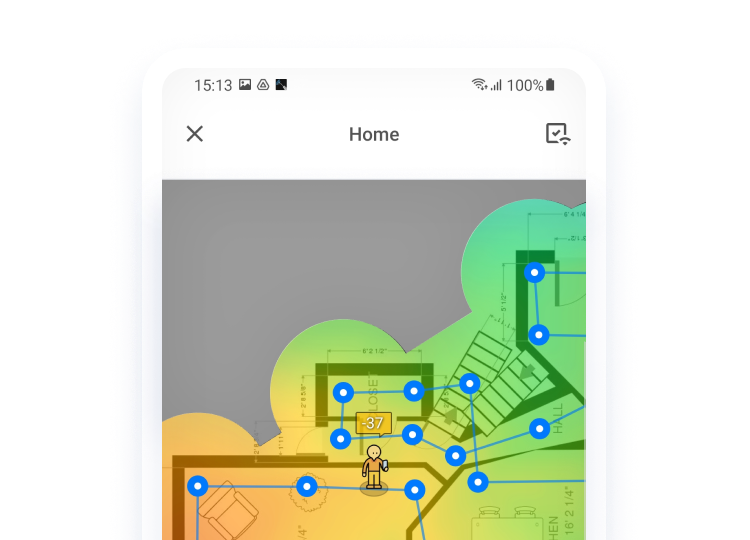
The data collected by the mobile version of NetSpot can be imported into the desktop version for additional analysis. You can continue to the following page for more information on how to perform WiFi site surveys using NetSpot.
Conclusion
A WiFi site survey is not just a technical report. It is a practical way to replace guessing with measured data. It helps you see where coverage drops, where interference appears, whether access points are placed correctly, and whether the network performs well in the rooms where people actually use it.
The biggest advantage is that the data comes from your own environment. Walls, furniture, neighboring networks, device density, and access point placement are different in every home, office, school, café, or warehouse. That is why generic WiFi tips can only go so far. A site survey gives you first-party WiFi data you can act on.
With NetSpot, you can run passive, active, or predictive surveys, compare heatmaps, test changes, and build a clearer plan for improving your wireless network instead of trying random fixes.
SO, WE RECOMMEND

NetSpot
Wi-Fi Site Surveys, Analysis, Troubleshooting runs on a MacBook (macOS 11+) or any laptop (Windows 7/8/10/11) with a standard 802.11be/ax/ac/n/g/a/b wireless network adapter. Read more about the 802.11be support here.
Site Survey — FAQ
Why do I need a site survey?
You need a site survey to identify and fix common WiFi issues like slowdowns, connection drops, dead zones, interference, and capacity problems.
How often should I update or redo my wireless site survey?
You should perform a new site survey whenever there is a significant network change: installing additional access points, rearranging furniture, changing building materials, or upgrading to a new WiFi standard (like Wi-Fi 6/6E or 802.11ax). Even without major changes, many experts recommend annually rechecking coverage to ensure that environmental factors haven’t degraded performance.
Can a WiFi site survey fix my WiFi automatically?
No. A WiFi site survey does not fix the network by itself. It shows you what is wrong and where the problem is located. After that, you can make informed changes, such as moving the router, adding an access point, changing channels, switching bands, or adjusting your network layout.
How can I reduce interference from neighboring networks?
The best approach is to run a site survey and look closely at the channel analysis — this shows you exactly which frequencies your neighbors are crowding. Once you know that, you can simply switch your router to a clearer channel or turn on automatic channel selection. If the airwaves are completely jammed, upgrading to a dual-band router or a Wi-Fi 6/7 system is a game-changer, as they handle heavy network traffic much better.
What first-party data can a WiFi site survey collect?
A survey can collect signal strength, network names, BSSID, bands, channels, security type, access point details, and — during active testing — real performance data such as download speed, upload speed, and latency. This data is measured in your actual space, which makes it more useful than generic WiFi advice.
How do you conduct a WiFi site survey?
A standard WiFi site survey follows five basic steps to accurately map and optimize your wireless network:
- Set up your software: Install a professional WiFi site survey tool like NetSpot on your laptop or mobile device.
- Upload your layout: Import an existing floor plan of your space or draw a basic sketch directly in the app to establish a scale.
- Collect data points: Walk through the physical area, stopping at regular intervals to take signal measurements with a simple click.
- Generate heatmaps: Let the software analyze the gathered data to create visual signal and noise maps of your environment.
- Optimize the network: Adjust your router placement, tweak channel settings, or add access points based on the visual insights.
How do I troubleshoot slow WiFi in certain rooms despite having strong signal strength?
Even with high signal bars, network congestion, channel overlap, or device limitations can cause slow speeds. A site survey reveals the noise floor, channel utilization, and potential throughput bottlenecks. You may need to reconfigure channel assignments or add band-steering to boost overall performance.
When to run a wireless site survey?
Waiting for users to complain about the network is the worst time to run a survey. To avoid costly deployment mistakes, a survey should be conducted during the planning phase to identify structural obstacles and fix access point placement before buying hardware. The next check happens during installation to prove the network actually matches the design. After that, periodic audits are only needed when the environment changes — whether that means a new office layout, higher device density, or new interference from neighbors.

Get NetSpot for Free
Wi-Fi Site Surveys, Analysis, Troubleshooting runs on a MacBook (macOS 11+) or any laptop (Windows 7/8/10/11) with a standard 802.11be/ax/ac/n/g/a/b wireless network adapter. Read more about the 802.11be support here.